
Build web3 games + apps with ease
January 17 2023
Build web3 games + apps with ease
Our Co-founder & Chief Storyteller, Michael Sanders recently visited London to speak at the Enter the Metaverse conference.
We think and care about the topic deeply — building in web3.
From our own experience, we know that building web3 games and apps can be hard, slow, and complex. Making web3 games user-friendly and onboarding new users can be equally challenging.
Beyond installs, extensions, and seed phrases, developers need to consider how users will acquire crypto, in-game items or digital collectibles in the first place. There’s also the added friction of gas payments.
Developers need to determine how to query blockchain data and display relevant information in the UI, including assets, visuals, and balances. Should a marketplace be included? Or how should developers connect to nodes to ensure the game is always up and running? Which network or blockchain should the app be on? There are many things to consider, and all of this comes on top of trying to make a great product.
At Horizon, we know the journey is complex — we’ve encountered all these pain points and more while creating our own web3 game Skyweaver. Fortunately, we’ve solved all these issues and productized our solutions into Sequence: an all-in-one developer platform + smart wallet that makes building web3 games and apps easy.
This post details the key points covered in Michael’s presentation, which you can watch in full here. It shares our journey building Skyweaver and Sequence since December 2017, the insights we’ve gained, and how developers can accelerate their time to market by 2+ years, and still deliver their users a seamless web3 experience, by leveraging our learnings and product.
We will look at the pain points of building web3 games and apps, and how to solve those pain points so that you can get to market faster and focus on delivering your users an awesome experience.
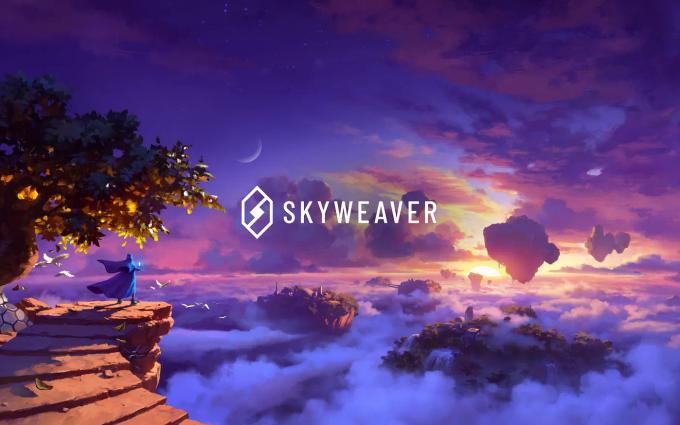
Five years ago, we set out to build Skyweaver, a web3 trading card game where players own their cards.
Right away, we realized a crucial problem.
Onboarding sucked
Just to get players started in a web3 game involves overcoming so much friction: wallet creation, seed phrases, downloading browser extensions, and more. A casual game player has to embark on a research project just to get started, which results in 90% of users dropping off. This is definitely not tenable for users or developers.
Pain points
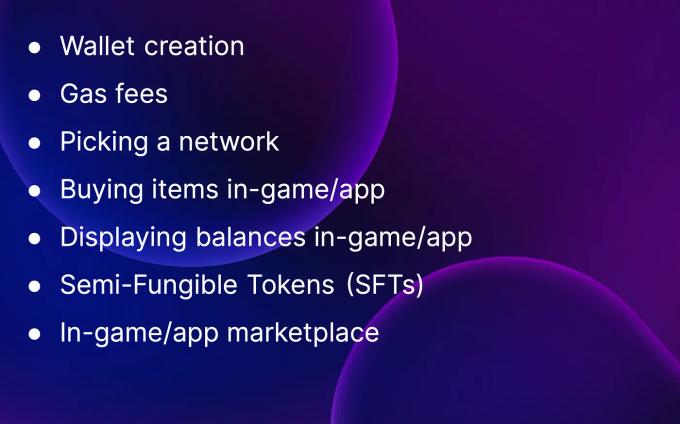
We identified seven pain points for building web3 games and apps:
- Creating a wallet
- Handling gas fees
- Selecting a network to deploy on
- Making it easy for users to buy web3 items like non-fungible tokens (NFTs)
- Displaying balances, the items users own, and metadata in-game/app
- Deciding the type of token for web3 items — are NFTs really best, or are semi-fungible tokens (SFTs) a better choice?
- Making it easy for users to trade items and for builders to monetize via an in-game/in-app marketplace.
Sequence: Build web3 games + apps with ease
To solve all these problems, we developed a number of tools to make building web3 games and apps easy. These tools now make up the Sequence all-in-one developer platform and smart wallet.
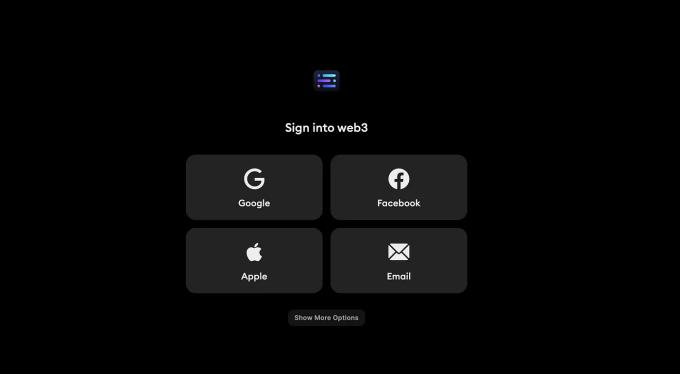
Wallet creation: make it seamless and non-custodial
Users will drop off when required to generate and record a 12-word seed phrase and download a browser extension to set up a wallet.
While some projects offer a better user experience by using a custodial wallet, this approach sacrifices security and creates liability for an easy sign-up.
Better user experience is essential, but a custodial wallet isn’t the answer — something we realized 4 years ago when we built and tested a custodial wallet before identifying a better option.
That option is Sequence Wallet, the smart contract wallet we subsequently developed and use today.
In two clicks with social or email sign-up, users can create a secure, non-custodial, multi-chain smart contract wallet that grants access to your app and all of web3.
This solves the onboarding challenge by delivering a familiar and seamless wallet creation and login experience, overcoming a key barrier to adoption while maintaining the self-custodial principles of web3.
Users don’t need to download anything, and the wallet is embeddable in any screen, game or app.
The Sequence Wallet provides outstanding web3 collectibles support and its multi-key design enables account recovery, providing users with peace of mind.
When users mint, buy and trade, the related transaction requires someone to pay gas in the native blockchain token. For example, on Polygon, payment for gas would be in the MATIC token; on Binance, it would be in the BNB token.
New users are less familiar with these tokens, which are volatile assets and require knowledge to use. Requiring gas to be paid in native tokens creates additional friction for someone just trying to buy a game item like a trading card, skin, or a digital fashion piece.
To solve the issue caused by gas payments, we built Sequence Transaction API, a meta-transaction relayer that lets you sponsor gas fees so that your users don’t need to think about gas at all.
Gasless transactions allow for better user onboarding.
Gas fees are negligible on a Layer 2 chain like Polygon, Arbitrum, or Optimism. Negligible fees make it easy to absorb gas costs because you enable users to spend much more in your game or app, creating a net positive.
Sequence Relayer ensures your transactions are fast and guaranteed, and with batching, they will save you and your users time and fees.
By parallelizing and batching transactions, you’ll achieve greater throughput, helping you to scale.
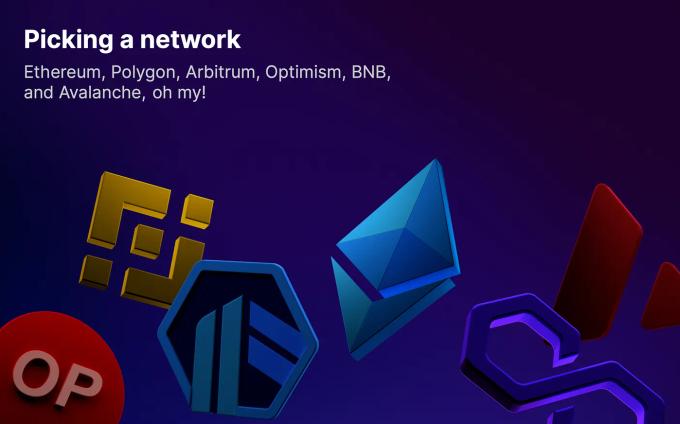
Picking a network
Selecting a network for your app is a major decision that can feel overwhelming.
We recommend deploying on an Ethereum Virtual Machine (EVM) compatible network like Ethereum, Polygon, Arbitrum, Optimism, Avalanche, or BNB Smart Chain.
Because these chains are EVM compatible, they are compatible with one another.
Ethereum/EVM is the future of web3 owing to its developer ecosystem, technical roadmap, community, history, ethos and liquidity.
The EVM ecosystem is large, with chains having different tradeoffs, but if your app is EVM-compatible, you can deploy on any EVM network. If the network you deploy on has a severe issue, you can migrate to another.
If you select a non-EVM blockchain and there is a critical network issue, you will need to re-architect your app, which could take many months or even longer. Choosing an EVM network gives you greater optionality, and security, and connects you with, by far, the most robust web3 ecosystem.
Our game Skyweaver was the first game to be built and deployed on Polygon. We chose Polygon for its scalability, instant transactions, low gas costs, security, roadmap and team.
The good news for builders is that Sequence is compatible with all EVM chains. You can leverage our complete suite of developer tools and wallet no matter which EVM network you select.
For users, it should not matter which chain you’ve built on. This is why using a multi-chain wallet like Sequence Wallet works well. It creates a seamless and intuitive experience for users who can store items from different apps on different chains all in one place.
Buying in-game/app items
Once you have built an awesome web3 game or app, you need to solve how users can buy your in-game/app items, whether they are SFTs or NFTs.
Until now, you would leverage a fiat onramp so that your users could purchase crypto with fiat before using that crypto to purchase in-game/app items.
However, onramps only have a 50% success rate because banks often block these transactions. This is because the transactions are viewed as “cash-equivalent purchases”, which banks do not favor.
A workaround is to use an NFT checkout, allowing users to purchase in-game/app items directly with credit or debit cards. Banks view these purchases as “virtual goods”, and transactions have a success rate higher than 90%.
Sequence has fiat onramps built in, and we are working on releasing an NFT checkout. By integrating Sequence Wallet, you can provide your users with automatic access to fiat onramps that leverage the global payment infrastructure of MoonPay, Ramp, and Onmeta, allowing for higher user spending in your game or app.
In-game/app balances
Even simple queries of the blockchain, such as checking in-game/app balances, can present challenges for builders.
When a user clicks on their inventory, they want to see their own items. But simply querying a blockchain node doesn’t always return the right answer, and queries are not so straightforward.
Chain reorganizations cause blocks to be invalidated later, and there are finality thresholds. You would have to watch every block produced to ensure your ownership information was up to date. And these are just some of the issues.
We built the Sequence Indexer, an indexer service, to resolve these issues.
The Sequence Indexer undertakes real-time indexing of ERC20 token, NFT and SFT transactions across EVM-compatible chains.
As a builder, the indexer allows you to easily query the blockchain and display the right assets to your users in real-time.
Node reliability is inconsistent, and every node provider we have tried has had downtime at some point. Node downtime would result in parts of your game, if not the whole game, being unavailable to players.
We built a node gateway aggregating multiple node providers, so your services and our indexer won’t go down, even if one node provider does.
If a node fails, Sequence automatically switches to another node without you needing to lift a finger, ensuring that your game/app will be up and running 99.99% of the time.
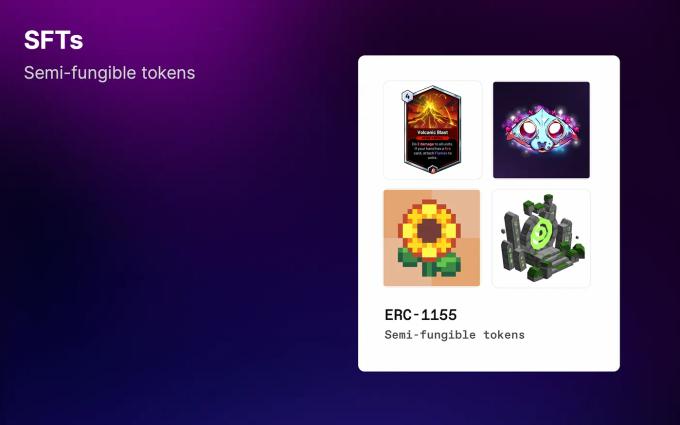
SFTs
Most games would benefit more from using SFTs than NFTs, although some would benefit from using both.
NFTs are well suited for unique one-of-one items like art, avatars, or real estate. However, most video game items, such as trading cards, skins, fashion, weapons, cars, and tools, have multiple copies. Game builders, therefore, should leverage the ERC-1155 SFT standard, which allows multiple copies of a given item with the same token ID.
Horizon co-authored the ERC-1155 standard four years ago because we needed it for Skyweaver and realized that most web3 games would also need it.
If you need an NFT — for example, for a unique piece of land — you can create that using the same ERC-1155 standard. So, you can create both NFTs and SFTs with the ERC-1155 standard.
Because SFTs enable batch transfer and multi-transfer in a single transaction, they also reduce gas costs.
SFTs enable deep liquidity that allows for instant buying and selling, which makes trading a much better experience for users and enables healthier markets.
With Skyweaver trading cards being SFTs, we needed to create an easy way for players to trade SFTs, particularly as we believed that most future web3 game items would use the ERC-1155 standard.
We created the open-source Niftyswap Protocol, an automated market maker (AMM) for SFTs that could be described as “Uniswap for game items and digital collectibles.”
The Niftyswap Protocol allows users to instantly buy, sell, or create a market for their items.
Because Niftyswap enables prices to be calculated algorithmically based on the ratio of assets in liquidity pools, users can sidestep the friction of buy and sell orders and the need to negotiate a price — something associated with most NFT trades.
The presence of an in-game or in-app marketplace makes trading instant, easy, and secure for players.
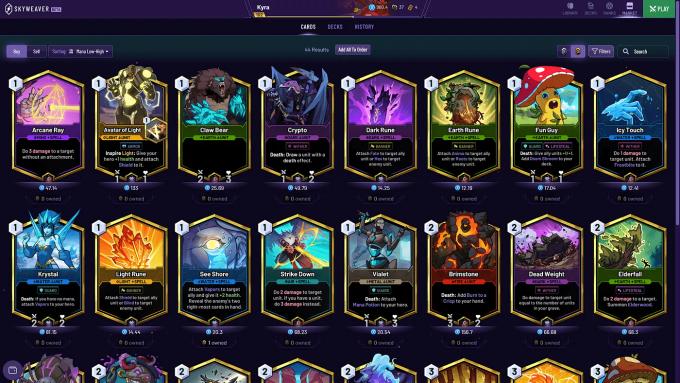
One example is the Skyweaver Market, powered by the Niftyswap Protocol, which is a highly intuitive experience for gamers, allowing players to buy and sell cards easily.
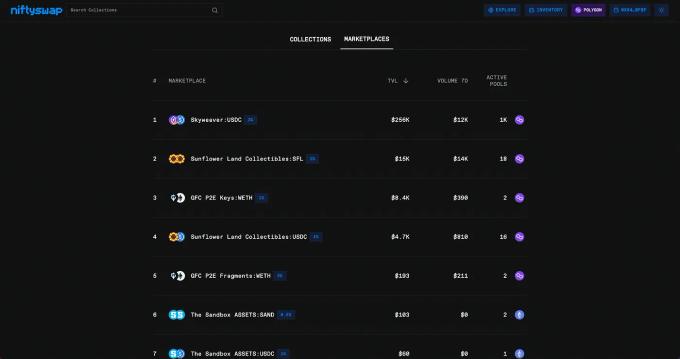
Niftyswap.io is a general marketplace for SFTs powered by the Niftyswap Protocol, where users can instantly buy, sell, or create markets for SFTs.
Sequence Marketplaces allow you to create the same seamless in-game or in-app marketplace experience for your users as Niftyswap.io.
It can be used as a complete no-code white-label marketplace or as an SDK on the smart contract for greater customization.
Builders can control the UX of the in-game marketplace and monetize trading activity by setting frontend fees.
Niftyswap.io can also be leveraged as a liquidity management platform for liquidity providers.
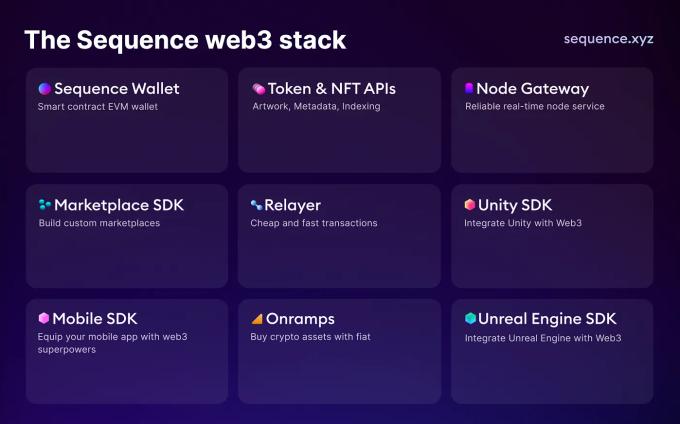
The Sequence web3 stack
Our web3 stack includes:
- Sequence Wallet:
for the seamless and secure onboarding of new users
- Token & NFT APIs:
for minting and distributing items and for indexing tokens and items so that you can serve the right data to your users in real-time
- Node Gateway:
to ensure your app is always up and running
- Marketplaces:
makes it easy for your users to trade, and for you to monetize the economic activity in your ecosystem
- Relayer:
for gasless, reliable, fast, and scalable transactions for you and your users
- Fiat Onramps:
make it easy for your users to acquire crypto and collectibles using a credit or debit card
- Web,
- Server,
- Mobile,
- Unity,
- Unreal Engine SDKs:
whether you’re building a web or mobile app, or a video game powered by Unity or Unreal Engine, you can equip your experience with web3 superpowers by leveraging Sequence
- Modular: the all-in-one platform has been designed to make building your web3 game or app easy. Because Sequence is modular, you can use as many parts of the stack as you prefer.
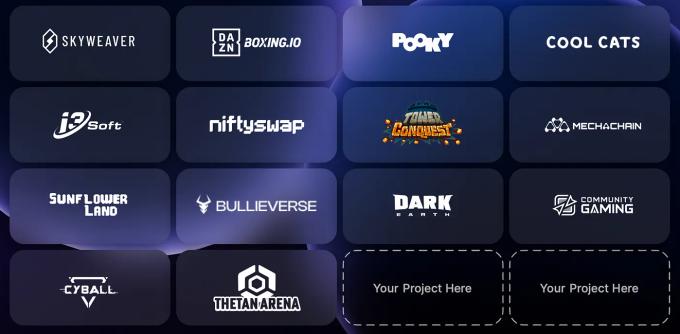
We’d love to help you bring your game to web3 and to market
There are some 50 projects that have already integrated with Sequence, or are in the process of building with Sequence, including web3 games like Skyweaver, Sunflower Land, Tower Conquest: Metaverse Edition, BoomLand, Ethernia, Mechachain, Metalcore, Mech, i3Soft, CyBall, and Dark Earth; NFT ecosystems like Cool Cats, DAZN Boxing, and Myntr; gaming platforms like Community Gaming; marketplaces like Nalnda, and OnePlanet; and there are around one hundred incredible web2 gaming and web3-native consumer applications in our pipeline, from small web3 startups to some of the world’s biggest tech and gaming companies.
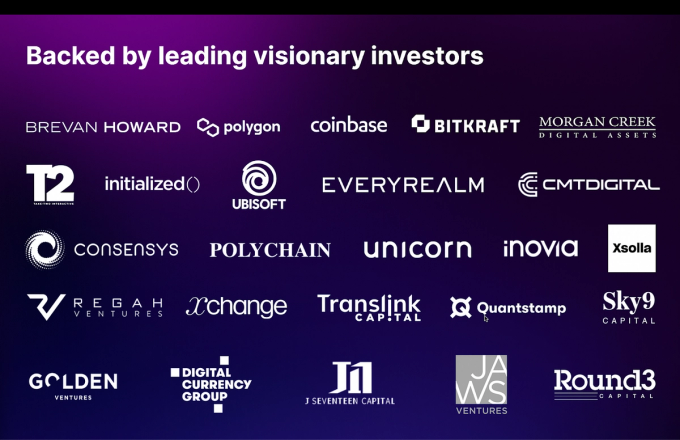
Horizon is backed by some of the world’s most visionary investors, industry-leading video game companies, and impactful web3 organizations and pioneers, including Brevan Howard Digital, Morgan Creek Digital, Take-Two Interactive Software Inc. (owners of Rockstar, Zynga and 2K), Ubisoft, Polygon and Coinbase. Key individual investors such as Shopify’s CEO Tobias Lütke, The Sandbox’s Co-founder Sebastien Borget, and Sky Mavis and Axie Infinity Co-founder Aleks Larsen have also invested alongside other funds, angels, and companies.
While building web3 games and apps can be hard, slow, and complex, Sequence makes it easier, faster and simpler to get your web3 product to market.
Let’s build together.
To watch Michael’s Enter the Metaverse conference presentation in full, click here.
Sequence makes building onchain simple. Developers and teams can launch, grow, and monetize apps with unified wallets, 1-click cross-chain transactions, and real-time data, all in a modular and secure stack. No more stitching together fragmented tools or battling poor user flows. Sequence is production-ready infrastructure that helps teams ship faster, onboard more users, and scale confidently. From chains and stablecoins to DeFi and gaming, Sequence powers developers and applications across the EVM ecosystem with billions in transaction volume and millions of users. Trusted by leaders in blockchain, Sequence powers today’s onchain apps and delivers future-proof infrastructure for tomorrow’s breakthroughs. Learn more at sequence.xyz.


Written by

Robert Guenette
Product Marketing DirectorShare this article


Related Posts
Today marks a major milestone: Polygon Labs is acquiring Sequence.
A short guide that explains exactly what gasless transactions are, and why they matter for your web3 experience.
In partnership with KOR Protocol, Sequence and Msquared, Black Mirror's franchise has launched the $MIRROR token and a new web3 experience!
Web3 payment flows allow any app to embed onchain purchases and interactions in a way that feels natural for users. Learn more about them!